


In the summer of 1990, we moved from Fort Sheridan, Illinois to Fort Buchanan, Puerto Rico, a small post on the outskirts of San Juan but still quite inside the larger city area. The city of Guaynabo was outside the post gate, and we were in a large metropolitan area. We lived in field grade officer quarters that were single family homes on a loop road up a hill. Our quarters had a large half circle back yard ringed by 29 coconut palms. It was lush and beautiful, but the lawn was so spongy and thick it was very hard to mow. Leif had that job and it was a hot, sweaty one which he did not enjoy. The coconuts grow in large clusters like grape clusters and are very heavy with the big husks that have been removed by the time you see them in grocery stores in the US mainland, and if they fall on you they can injure or kill you, especially since they can fall all at once. People soon learn not to park their cars under a bunch of coconuts, too.
Leif also learned to use a machete to clear brush around the yard, and he was good a loping off the end of a coconut so he could drink the juice. I once looked out the window an saw him stripped to the waist after mowing the lawn, with a coconut impaled on his machete, holding it up and literally pouring the juice into his mouth from above. With his tanned skin and long hair, and muscular body, he looked like Tarzan out there. I wish had I gotten a photo of that, but he refused to pose for me once I got the camera.
There was also a big mango tree at the far edge of the back yard. Mangoes are delicious when properly ripe, but when myriads of them fall to the ground and spoil they smell like turpentine.
From time to time, a small flock of blue macaws would fly over about five a.m. making a fearful racket. They were beautiful to see, though, so we didn't mind. Less edifying were the rats that ran along the electric wires and up the palm trees, and tropical roaches are enormous. Luckily we never had either of them infest our house.
The house was made of concrete block. When we were there, the quarters did not have central air conditioning. Instead, the screen was on the inside and the windows (except for the big picture windows) had no glass and the outside of them were aluminum louvers that could be opened at any angle or closed. You could open up the house and let the breezes blow through. The trouble with this was, those of us coming from the north couldn't take the heat and humidity, and neither could our belongings. Without AC, everything soon got mildewed. So, in those days, we bent one or two of the louver frames outward, took out the screen, and installed a window AC to cool the place and lower the humidity. Then we had to cover the screen on all the other windows with clear plastic to keep the AC in. Leif helped install the air conditioners.
His school was just down the hill, but to get there you had to take a trail through want amounted to a tropical jungle. He attended Antilles High School for his sophomore and junior years of high school. I've already posted photos and accounts of what happened when he tried to be on the soccer team, how he became a certified SCUBA diver and helped do underwater cleanup, and how he was in the musical "Grease" playing the part of Kenicke. He also had a small part in "Guys and Dolls" the precious year. I've also written about the guitars he had, including the one he designed and made while in Puerto Rico, the band he played in for a short time, and his friends. I don't remember the names of all of them, but I do remember Lenny, Ricky, Jill, Rebecca, Janice and Clarissa very well, and his guitar teacher, Edwin Santiago.
When Leif first got to Fort Buchanan, he had some difficulties. Antilles High School was an American school on a U.S. Army base, but most of the students were children of people working for various civilian federal agencies like the Treasury Department or the FBI, and most of them were Puerto Rican. This meant that although the classes were all taught in English, during breaks and after school, most kids were speaking Spanish. Despite his abilities Leif never really learned Spanish and his friends were mostly children of the "norteamericanos." During his first few days of school, he got "tested" as the new "gringo" and was attacked and beaten by some of the locals on a pretext. One of them hit him in the face with a ring that made a nasty cut and bruise. I caught him one day heading to school with a pair of nunchucks stuck in the back of his waistband and told him he couldn't take them to school. He said he needed to defend himself. He knew how to use them, and I was afraid he would injure or kill someone if he tried to defend himself with them. I insisted he would have to either find a way to get along or we would talk to the school about the situation. I think that was when Leif learned the macho walk, the intimidating carriage that made people think he was not to be messed with, and when he began to formulate his belief that a man should show no weakness. He had no further trouble with those guys, but to my knowledge, there was no more fighting.
Inside the house, we had a small kitchen, a large dining room-living room combination, a kind of enclosed porch we used as an extension of the living room, and three bedrooms. Leif's was decorated in his favorite black-and-white color scheme.
We saw as much as we could of the island of Puerto Rico, from the beaches to the mountains, from the cities to the countryside, and while there, we also took trips to the U.S. Virgin Islands and a Carnival cruise to the Caribbean. We especially enjoyed Old San Juan and the fortress of El Morro and often shopped at the San Patricio Plaza shopping area.
Puerto Rico was where Leif really came into his own as a young man. It was where he first fell in love with Karen, who he carried a torch for for a long time. It was where he first acted and sang on stage, where he first gave parties and had a group of really great friends. We were very sorry to have to move him from there to Kansas after his junior year when Peter W. retired from the Army. It was hard for him to leave his friends behind and start over as a senior in a new place.
When he graduated from Manhattan High School in Manhattan, Kansas, his primary graduation present was a trip back to Puerto Rico to see his friends and be there with them when they graduated.
-------------------------------
The photos are:
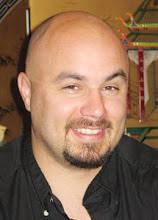
1. Leif in the spring of 1992. This photo was actually of him and Karen in a car on a date, but I cropped it to show only him. I think he looks like he could have been Puerto Rican. This was the first time he wore a beard and mustache. Note the earring and his already-receding hairline.
2. Leif in April 1992, also originally of him and Karen.
3. Leif by the sea in 1991, with El Morro and San Juan in the background.
4. Leif by the sea in 1991 with "many faces" caused by a filter Peter W. used to take the photo.
5. Our quarters (house) in October 1990.
6. The back yard of our quarters in October 1990.
7. The back yard of our quarters looking from the far end of the yard in October 1990.



 Posts
Posts

