

On July 5, 2006, Leif sent this to me as a text message, after his apartment was robbed in the afternoon in broad daylight, the thieves making off with $7,000 worth of property including computers, cell phones and guns:
"I am OK. You know me. I am the rock. Also the good thing about my life of having once been so dark as to make me want to end it in overcoming it means there is nothing I can't handle. After that everything else is just a new adventure or challenge. I am so much stronger now. This did not even raise my pulse. Just a speed bump. The car is still running great. I see it almost as a good thing, it will allow me to move out of here."
Leif seemed to absorb the many difficulties he faced with equanimity, and often to turn them into something better. In this case, he moved out of an apartment complex which he had come to hate and see as a den of crime into a better one, replaced his property with newer things, and went on with his life, as if it hadn't affected him, though it had.
He had to break his lease to move out, and although the apartment complex had done nothing to secure his (and his girlfriend's) safety after the break-in, or even repair the damage to the inside of the apartment, they came after him for a lot of money. The complex was owned by one of New York's worst slum landlords, according to newspaper accounts. It took two-and-a-half years of contesting it, but they finally seem to have ceased trying to collect.
At the new place, barely seven months later his beloved Suzuki motorcycle was stolen from the parking lot.
During the same period, he went through job and personal difficulties and faced his continual money problems.
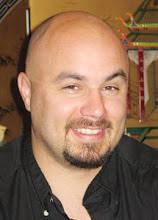
The two self portrait photos above show clearly the decline in his mental and physical health. The earlier one was taken in March 2003, when he was about to graduate from Kansas State University and had finally climbed out of his deep depression after his marriage breakup and his problems with the army and his asthma. This was the picture that he liked enough to make it the profile photo on his MySpace page.
The later photo is another self portrait he took in the parking lot at his work, November 21, 2007, ten days after he sent me this message:
"No things are not bright. Rather dark actually as I struggle to find purpose. ... I miss having a purpose. A reason to keep trudging on despite the fact that each day holds far more difficulties and irritations than it holds joys or pleasures."
It was that message (and the rest of it) that made me so worried about Leif.
At that time his quest for love was failing, no matter how hard to tried to find someone. His quest for a career was not going as he hoped and planned. He was in pain from the motorcycle accident on July 12th that put him in the hospital for the operation that screwed a 9 inch metal plate to his broken collarbone. He was spiraling downhill. I was extremely worried about him.
Then end of hopes and dreams is a terrible thing, a life-killing thing, but he seemed to come out of it. We had good visits with him in January, February and March, but he continued to exhibit one of his faults . . . denial of problems, both financial and emotional.
Leif had many wonderful qualities, a brilliant mind, a great sense of humor, incredible physical strength, but he also, like all of us, had faults. He knew what some of them were, and listed them in the quote I put on yesterday's post, but there were some he denied to himself and others.
Leif could be inconsiderate and uncommunicative, aloof and evasive. As his mother, I had to learn to deal with those qualities without becoming angry and punitive. If Leif didn't want to answer a question, he would simply ignore it or give evasive answers.
When he came back from the army in May 2001, he lived with us briefly over the summer until he got admitted to KSU and found an apartment in August. He was welcome to have dinner with us any day he was there, but all we asked was that he let us know if he was going to be there so we could have enough food and not be waiting for him if he wasn't going to show up. But that was apparently too much to ask. He wouldn't do it, and I had to ask him every day whether he would be there. Sometimes he was willing to commit himself, sometimes not. He didn't want to commit himself in case something better came along, but all we asked was that he let us know two hours before dinner.
That's just a small example of the ways in which Leif could be inconsiderate or rude, and yet when he was there with us, we invariably enjoyed it!
Leif liked to drive fast, very fast. He could ill afford to pay for a speeding ticket, but he said the price was worth it to drive the way he wanted to. He had no regard for speed limits.
He was an excellent driver, and would have liked to be a race car driver, though that wasn't a possibility for him. We worried that he would end up disabled or dead because of an accident in his car or motorcycle.
He actually did have an accident with nearly every vehicle he owned. Although they wre not his fault, there is a good possibility that he could have avoided at least some of them by slower, more defensive driving.
The first car he had was a used Mazda RX-7 that we bought for him when he was in college. He loved that car. At an intersection on the west side of Manhattan, Kansas, another car didn't yield the right of way and to avoid it, Leif slid the RX-7 into a light pole. There was luckily little damage, but the insurance money allowed him to have the car painted.
His first motorcycle was a yellow and maroon Yamaha. He loved tearing around on that, too, but he was coming down a hill on Fort Riley, a winding steep road, and slid out on some sand at the edge of the road. The resulting crash did little damage to the cycle, but the jeans on Leif's leg were scraped right off of him and his leg had a terrible case of "road rash." He didn't have medical insurance and didn't want to pay for a huge hospital or doctor bill, so we went home, nearly in shock, tried to wash out the sand and gravel himself, and hoped it would heal. He didn't tell us about it until days later when it had started to scab over and heal, and although he did have some infection, he luckily got better on his own.
When he graduated from KSU in May 2003, he needed a car. His old one was past repairing except for someone who wanted it as a project car, and he sold it to a man and his son who wanted to work on it together and fix it up with parts from a junk yard. We knew he didn't have the money for a new car, nor a way to pay the payments on one because he didn't have a job yet, so we offered to buy a car for him and he could pay us back once he had a job.
We got him a sleek, black 2002 (new) Dodge Stratus. It was a great-looking car and he enjoyed driving it, though Leif would ALWAYS head to all the dealerships in any town where he lived and try out cars to see what else was there. It was a major pastime with him.
When we moved him to Florida with us in March 2005, we shipped the Yamaha cycle (which he later sold and bought the Suzuki), and he drove the Stratus down. I think it was December 22, 2005 when he called me to tell me he had just been in an accident in Tampa, again at an intersection, and his car was badly damaged and he had a hurt neck. The car turned out to be totaled, and although we had paid cash for it, Leif still owed most of the money to us. His neck continued to cause him pain for the rest of his life.
He got the insurance money, used it to pay off his Suzuki bike loan, which was at a higher interest rate, and promptly found a beautiful used Mazda RX-8, which he got a loan to buy. He had a hard time making those payments after he moved into an apartment in Tampa, the car and insurance payments took about $700 a month out of his pay! He never had an accident with the RX-8, a car he truly loved, but when he died and there was still $16,000 owed on the loan, we had to let the bank repossess it.
In May 2007, after the Suzuki motorcycle was stolen, Leif took the insurance money and purchased his last motorcycle, a 2002 Honda VTX 1800C. It was a completely different style from his two previous "crotch rockets," being a touring bike that was more comfortable to ride. He had it only two months when on July 12, 2007, he was on his way back to work from lunch on 56th Street in Tampa when a white Cadillac cut in front of him. In order to avoid a collision, he "laid the bike down," and him with it. That's when he got the broken collarbone I mentioned earlier, along with nasty road rash on his hands and bald head. He said he would always wear gloves after that, but still resisted wearing a helmet.
Within the space of the three years he lived in Florida, Leif experienced three vehicle accidents, a love affair gone wrong, problems with one job, restructured pay scales at another that made him have to leave for a better paying job, disillusionment at the third one, an apartment robbery, a stolen motorcycle, a motorcycle accident that ended up causing him a lot of pain, and financial problems that finally got out of hand.
yet like most men, Leif denied depression, even when he was clearly depressed. That's why that email admitting that life was "rather dark" concerned me so much.
I can't look at the difference in these photos and not see that he had become depressed. There is hope and even innocence in the earlier photo. There is a kind of grim sadness and disillusionment in the latter.
Leif use to insist to me that he had no regrets. I had a long talk about this with him once before we moved to Florida. I asked him whether that was true even after all he had been through (much of which I haven't written about in this blog) and some of the choices he made, but he insisted that he wouldn't have done anything differently, that he had no regrets.
I don't know whether he still felt that way when he died. I didn't have that kind of conversation with him again, but knowing Leif, he would probably have still insisted that he would not have changed his actions or his choices even after experiencing the outcomes.
But who knows? Was that just a big front, male defensiveness? I don't know. Maybe it's possible, that despite the heartache and physical pain, he would not have been willing to give up the experiences he had.
I wish he had still been as strong as he said he was on July 5, 2006. He would still be here.



 Posts
Posts

